The Scottish guitarist spoke with us about his love for old blues and the filming of the Vincent Moon concert documentary
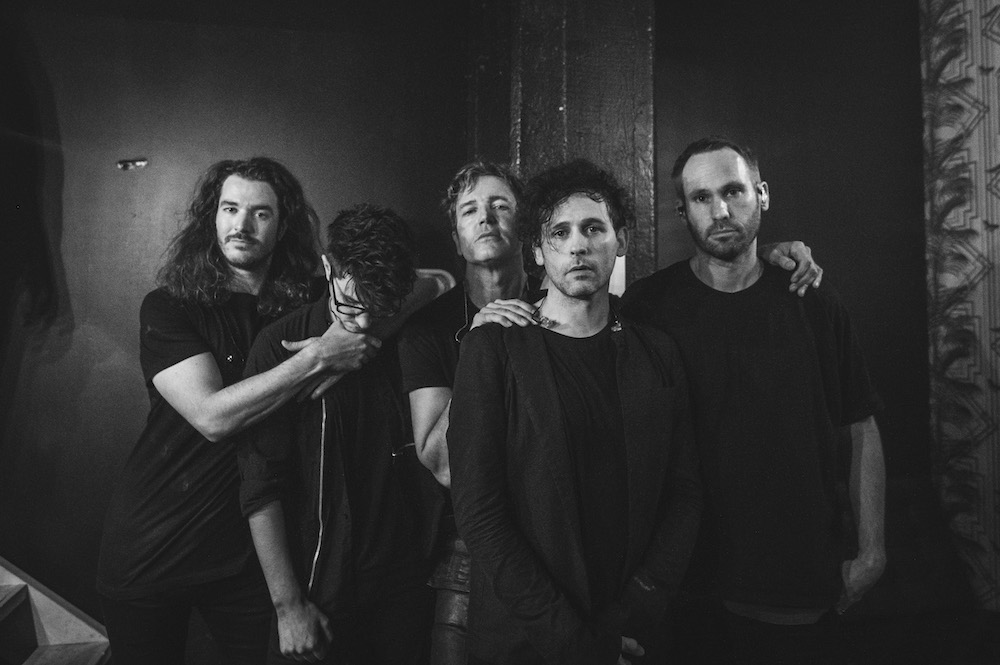
Last night, filmmakers Vincent Moon and Nathanaël Le Scouarnec, and Glaswegian post-rock band Mogwai brought it all back home with a screening of the concert film “Burning” where it was shot last year—the Music Hall Of Williamsburg in Brooklyn. The film is an intimate look at Mogwai’s career, and combines bleak scenes of New York with beautiful (albeit claustrophobic) footage of the three-night run. Despite being absent from the screening, Mogwai’s guitarist Stuart Braithwaite spoke with us from Scotland about the film and what it says about the band’s career moving forward.
Death+Taxes: How did Mogwai get involved with filmmaker Vincent Moon for “Burning”?
Stuart Braithwaite: We’d worked with him once before on our short film ["Before It Sounds"] that came with “The Hawk Is Howling” album, and we really liked the film and enjoyed hanging out with him. And, yeah, we were talking and doing a live thing.
Did Moon prep you for the shooting of the film?
SB: Well, we had the songs we wanted in the film. We had to make sure we played those songs. And he wanted a lot of close-ups. So we actually played the songs in the afternoon of the shows quite a few times as well. He filmed our hands and all that kind of stuff. So there was a little bit of direction—nothing too drastic. There were a few things we wouldn’t have done normally if we weren’t getting filmed.
That was something I noticed—the close-ups in particular. It’s a really claustrophobic film, and there aren’t many shots of you guys as an entire band. Did he tell you why he wanted that specific shot?
SB: No! [laughing] We’ve never made a concert film before and just thought that was normal!
Now that you have recorded your first concert film do you think it provides a different look at the band for fans? Does it personalize the band a little bit more for these people?
SB: It must. There must be people who probably have never seen us play before, and probably don’t even know anything about what we look like. I think it’s more just a different facet of the music. It’s more just a different way of experiencing it. I think there are probably some people who really love our records and aren’t that interested in seeing us play. And maybe the other way around—people who like our shows but aren’t that interested in our records. It’s good to have something permanent to sort of commemorate the concerts since we’ve been doing them so long.
Mogwai has been around since 1995. From your first album “Mogwai Young Team” to 2008′s “The Hawk Is Howling,” how have you guys evolved as a group?
SB: Well we’ve grown from our first album. I think the music’s changed. I think there’s a lot more complexity in the songs that we write now. In looking at the film, “I’m Jim Morrison, I’m Dead” is far more complicated than some of the older songs. You may prefer the older ones to the newer ones but there’s definitely a musical change that’s happened over the years. A lot of it has been quite organic.
After 15 years, do you think Moon’s film serve as a retrospective for you guys?
SB: Yeah, I think it does. I think the BBC sessions record, which came our four or five years ago, really kind of stays. Maybe that was more of our retrospective because it was from a different period, but in one night. I think it’s more of a summation.
Some people have harped on you guys over the years for the lack of vocals. Do you think that the sparseness helps drive your songs with the tension that you have previously talked about?
SB: That might be true. Our music has a real openended-ness which I think comes largely from not having any vocals. People can take any interpretation that they want from the music. So some people will think a piece of music is really sorrowful and someone else will think it’s really joyous. I think there’s more, without sounding pretentious, a kind of awake-ness to our music. For how someone feels about it is up to them compared to a song. Which isn’t to say what we do is superior in any way. If there’s a song with a direct story then the margin for interpretation is much smaller.
I’ve noticed that you, and the band, are fans of social media—Twitter specifically. And on your feed I read that you’re back working with your producer from “Mogwai Young Team” Paul Savage. How did he come back after 15 years, and does this mean a new record is in the works?
SB: We always were friends. I think it was because we got a kick out of some of the records he was making recently. He recorded the last Twilight Sad record, and we all just really loved it. And we we’re thinking to ourselves, “That’s a great record. We all like Paul. Why don’t we call Paul again.” The story with that is a bit of a weird one. Our first album, even though a lot of people love it—we didn’t like it. I think the experience of it was pretty brutal. The only time we’ve made a record and not really enjoyed it. And it was nothing to do with Paul. There we’re a lot of things going on at the time that just weren’t helping anything. So I think maybe it’s taken us 15 years to get over the recording of “Mogwai Young Team.”
So that means you guys are working on a new record. When do you expect it to come out, and how will it be different from “The Hawk Is Howling”?
SB: February, probably. Hopefully. I think it will be a bit faster.
So what have you been listening to recently?
SB: I’m listening to right now a lot of hip-hop, and a lot of old blues. Like Blind Willie Johnson, Skip James and Missisippi Fred McDowell. And a lot of hip-hop like Nas and Wu-Tang Clan.
Do you think any of that will influence the new record?
SB: Probably not, no. I’ve never tried rapping and I’m not a very good blues guitar player. So I would guess, no.


November 22, 2010 at 4:26 pm, Free Music Monday with Ryan Adams, Mogwai and Sufjan Stevens | Death and Taxes said:
[...] in July, Mogwai’s Stuart Braithwaite told us that there was a new record in the works for the Scottish prog-rockers. And so there was. [...]