
D+T’s Drew Fortune checks in with Brooklyn’s Here We Go Magic.
In the final moments of the “Seinfeld” finale, Judge Vandelay fixes Jerry, George, Elaine and Kramer with a curious stare and states, “I don’t know how, or under what circumstances, the four of you found each other.” Brooklyn’s Here We Go Magic are a lot like the Seinfeld gang, plus one.
I’m dining with all five members of the band on a cold, gray afternoon in an upscale hotel in Austin, Texas and midway through my interview, I’m chuckling to myself. It’s almost as if we’re having lunch at Monk’s Café. The band talks over one another, takes digs at each other’s musical tastes while obsessing over minutiae. Like so few bands I’ve spoken with, at the heart, they clearly love each other’s company. While an afternoon interview on a shitty day may be just another nuisance forced by publicists, Here We Go Magic enjoy the act of simply sitting down to lunch together and talking about themselves.
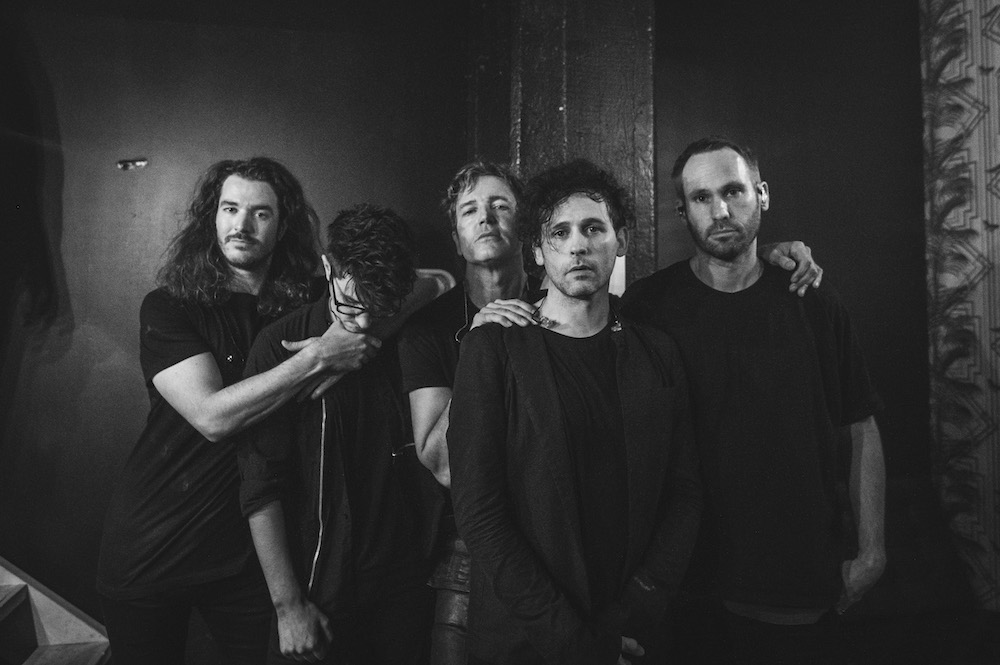
The role of Jerry Seinfeld clearly goes to bandleader Luke Temple, whose insistence on schedules and boxes of unused lyrics borders a bit on the neurotic. He also has the sharpest tongue of the bunch. To his right is the designated Elaine, keyboardist Kristina Lieberson. She’s the youngest of the band, but her self-assurance, tough attitude and sex appeal keep the other band members on their toes. Guitarist Michael Bloch plays the role of George Costanza: he’s short, with a touch of a receding hairline, but shares George’s wit and wry sarcasm. Then there’s drummer Peter Hale, his towering, lanky frame and booming voice making him the perfect Kramer. The only outlier is bassist Jennifer Turner, the designated housemother, whose bedroom eyes and hippie mysticism would make her a great lead in any series.
Here We Go Magic’s 2009 self-titled debut caught a small fire last year, sending the newly formed band on the road with Grizzly Bear, and the group has been slowly building their audience ever since. The eponymous debut detoured a bit too far into the woozy, noise psych of Animal Collective, yet on the new record “Pigeons” (Secretly Canadian) the band has found a unified sound, with the unique sensibilities and background of each member adding texture and flavor. What began as a pseudo side project for the prolific Temple has bloomed into a collective with overflowing imagination and musical experimentation to spare. In each other, the band has forged a somewhat dysfunctional family of kindred spirits and musical oddballs.
What was the initial chemistry that brought you together?
Luke Temple: It was all pretty coincidental. Some of us had been friends prior to forming the band, and had occasionally played music together, in different capacities. The alchemy of this whole group coming together was all just a series of coincidences. It was fate, really.
Peter Hale: The chemistry wasn’t all there until Jen came onboard.
LT: Initially, we had a different bass player. The second she joined, it was like we suddenly became a real band.
Kristina Lieberson: I remember that first practice with Jen as being a moment when we could all just really explore for the first time.
PH: The light in the room was suddenly different.
How do you guys get along as friends?
PH: We’re like this weird little family now, with an emphasis on weird.
Michael Bloch: I think we’re different enough personally, which creates healthy tensions and makes the music stronger.
LT: We don’t have to talk very much about the music. That just kind of takes care of itself. We have a lot of personal differences, although nothing contentious. It just converges in a very nice way.
Luke, do you find yourself writing differently than you did solo?
LT: I still write all the songs, but I keep them a lot looser and simpler, because these aren’t songs that I could carry on my own. I used to write a lot more intricate guitar parts for songs I would perform solo.
Jennifer Turner: On your last solo record, it felt like the songs were really loose.
Is it hard to relinquish that creative control?
LT: No. I still write the words and the songs so I’m happy. The way everyone comes together and arranges material as a band is really free, and everyone is encouraged to do whatever they want. I’d rather have it that way. The way everyone brings their own voice to it is as important as the initial bones of the song that I wrote. That way we’re really a unit and striving to develop our sound together. The overarching sound is what we do together.
Jen, tell me about your influences and how you first found Here We Go Magic.
JT: I loved Violent Femmes and Pink Floyd growing up. I’m the bass player in the band, but I still play guitar. I hitchhiked around for a while following The Dead. It wasn’t really the Dead that were inspiring. It was the freedom of that lifestyle. I learned how to play guitar from hitchhiking and being around campfires. I’d attach myself to one person and learn everything I could, and then move on to the next person. I got into indie rock because I got tired of everything being so polished. I was really interested in hearing things that felt natural. I like things that are inspired by the moment and not a thought process. When I first saw Magic, it was one of their very first shows. I saw the band, and they immediately became my favorite band. I was like Jane’s Addiction, Led Zeppelin, The Microphones and Here We Go Magic. It became my new obsession. I said, “If you ever need a bassist or guitar player…please,please, please just give me the chance!” The next day, it just so happened that they didn’t have a bassist so they gave me a call. Very karmic.
Tell me about the recording of “Pigeons.” You came together as a band and started recording almost immediately. Did it take awhile, post-honeymoon, to really get to know how each other played and how you worked together as a band?
KL: It took a bit.
LT: We had been touring a lot before we recorded ‘Pigeons.’ There were some songs that we were already playing live, so it seemed most efficient to record those songs first. When we started recording those, for whatever reason, they just felt uninspired. It didn’t have the sense of exploration that we love. Then we went through a dry-spell during the first few weeks, so we put that stuff away. I get really freaked out by that kind of thing by the way. I lose it. I don’t like stepping backwards, and I don’t like feeling like time is being wasted. I attack.
KL: Confrontation!
LT: For me, it was a real process learning how to work with a group, because I’d always just done it myself. At the beginning it was tough, but then we just decided to write all new stuff. We wanted to be spontaneous, and decided to write a song a day.
PH: Write and record a song a day.
LT: I would get up in the morning and write a song. I didn’t really think about it. The important thing was just writing. The band would wake up, I’d play it for them, and then we’d record it. Once that started to happen, we got really excited. We were getting really cool sounds because we weren’t thinking so much about the engineering but just capturing that spontaneity. We were really loose about how we were mic-ing drums, and all of a sudden…
JT: It just felt really good
LT: After we really started building steam, we decided to take a crack at those other songs that weren’t working before. We decided to do them live, with this spirit that we’d been building. We did that, and those songs finally took shape, and all of a sudden we had a record. The essentials of each song were basically all recorded live. A few overdubs after that. There’s a real human, alive feeling about the record.
Tell me about the recording process.
KL: Jen did all the engineering and producing.
PH: We went to this house in upstate New York with the bare essentials of production: a board, a few mics and an eight track.
MB: Lots of really fine wine and game birds. Secretly Canadian would love to know how we spent our advance.
PH: In the house, we all found our little spaces. The girls would spend lots of time singing to each other in the back room, recording themselves. The whole thing had this living, breathing, organic spirit to it. There was a constant flow of motion. Anyone who lived in the house contributed something to the record. As far as engineering and producing, that was all Jen.
Did you have to be the housemother by default then?
JT: I’m not a whip cracker per se.
LT: If anyone did that, it was me. I’d be like, “Wait a minute! It’s noon and we’re not recording right now? What the fuck?”
KL: Jen brought out what we needed. During recording, if I got frustrated with a take, she’d have us try it another way until we felt comfortable.
JT: It was so fun.
KL: But you’re so good at it.
PH: It was really magical. She’d sit there with the headphones on, reading Steinbeck, while we’d just be failing over and over again. She’d just say, “It’s ok. You’ll get it.” Then she’d go back to reading. Finally we’d succeed and she’d be like, “I think we should keep that take.”
2009 must have been a whirlwind. How are you adjusting? Are you wary of blowing up too quickly?
PH: The creative output is so strong that there’s no way it could outpace us.
LT: We’re all in our thirties, except for Kristina, and I’ve been doing this for ten years. It was baby steps, and I couldn’t even see my own progression for years and years. I don’t even know if there was any progression. And then all of a sudden, things are going well. Whether it was a Luke Temple project or Here We Go Magic, I personally feel like I put in my time.
KL: I think that’s true for all of us.
PH: Luke’s been making beautiful records for ten years, I’ve been in bands since I’ve been in New York. Maybe if we were younger, dumber and more anxious, it might be a problem. We sometimes move a little too quickly for ourselves, so our output is outpacing the mode of production. We could make a new record every few months probably or just tour constantly, but that would wear us down.
MB: All we need is for Luke to let us dig into his boxes of private lyrics.
Any crazy road stories? Are you all upstanding citizens?
LT: No, we’re old.
PH: You guys are all getting into organic juices.
LT: Yeah, I try to exercise every day. We’re really obsessed with eating well too. Those crazy days are over. We want this to continue, and don’t want anything to bring us down. If we start getting into shit on a seven month tour, we’d just destroy ourselves. We’re just trying to figure out the most economical way of doing the tour and staying sane.
PH: We have crazy jams and smash shit up though.
JT: We jam in the middle of restaurants and people get really annoyed.
At the end of the day, what makes you happy as musicians and human beings?
JT: Oh, that’s a nice question!
LT: For me, it’s a sense of being fearless and letting myself be expressive. When I can do that, then I can let my gifts shine. It’s my own brain that gets in the way. So whatever helps me to feel free and confident, that’s what makes me happiest.
KL: Being present is really important. Being in the moment, and a combination of being supportive and being supported.
JT: That’s exactly how I feel. When you’re playing onstage or involved in a conversation or communicating with yourself, feeling fearless and present is really what matters.
MB: Communication, and a feeling of being part of something that is recycling energy. It’s kind of like surfing, and you just feel a part of this shared rhythm. We’re all different people, but we derive our happiness through our shared creativity. If we weren’t that way, than we would butt heads.
PH: I love when we’re playing, and there’s a moment when I feel like I’m in a circle. It’s not a physical thing, but I feel like it’s all panoramic, and I’m getting something from each person on stage. I’m getting something from all these people, and that makes me happy. It’s really groovy.


October 15, 2010 at 6:31 pm, Live Review: Here We Go Magic at Bowery Ballroom | Death and Taxes said:
[...] most indie rock bands that play at the Bowery, Here We Go Magic put on a full show replete with showering neon lights and pillowy smoke [...]